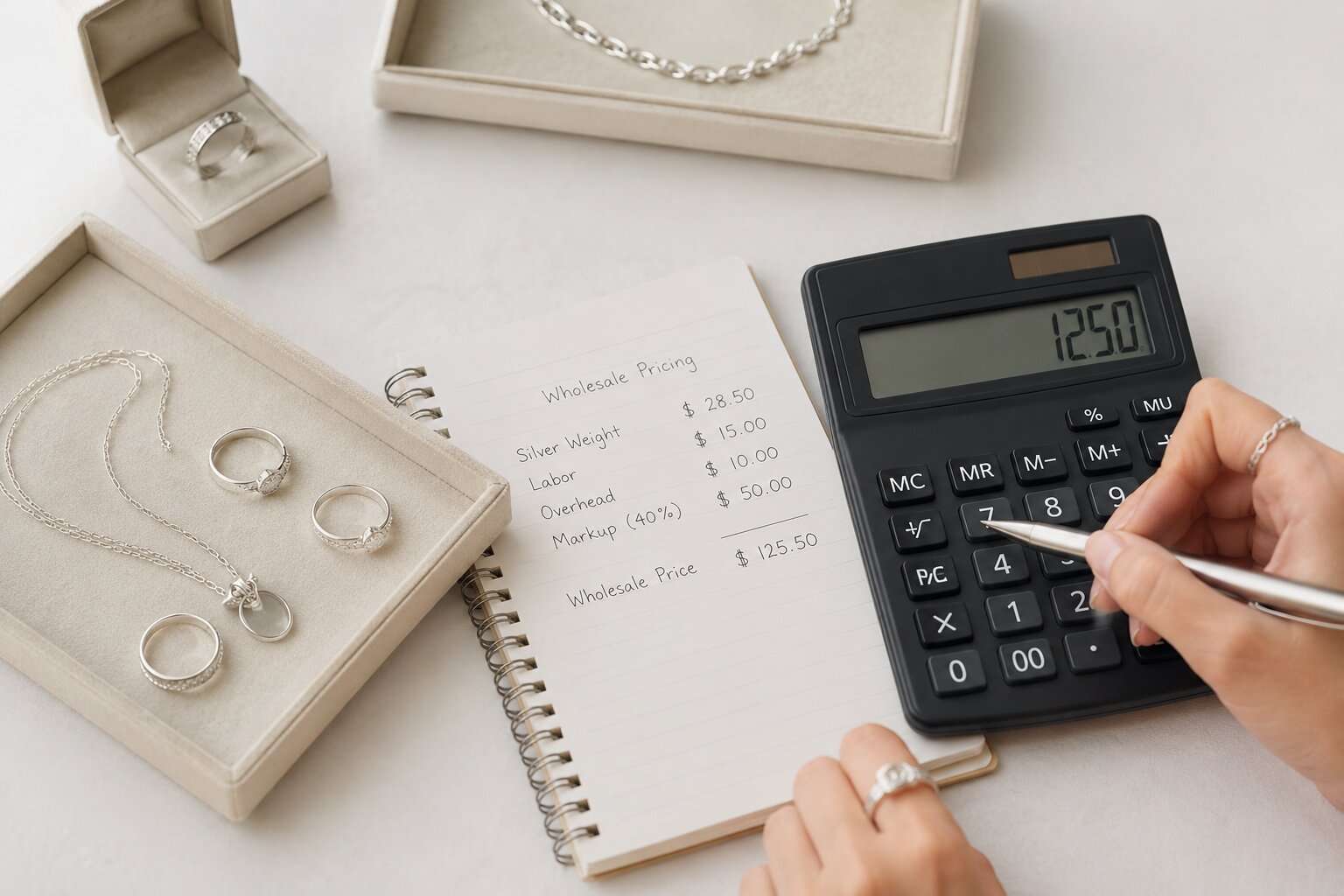
Wholesale silver jewelry is priced from the value of the silver in the piece, plus the cost of turning that silver into jewelry, plus the supplier's margin. The price then drops as order quantity rises. Because the silver part follows the market, the same design can cost more or less from one order to the next.
This guide shows how to read a wholesale quote, how to calculate the silver cost yourself, what else moves the price, and how to turn a wholesale price into a retail price.
Most quotes combine these layers, even when the supplier shows only one number per piece:
| Layer | What it covers |
|---|---|
| Silver | The silver content of the piece, based on weight, purity and the market price |
| Making cost | Casting or stamping, assembly, polishing |
| Surface and extras | Plating (such as rhodium), stones, oxidized finishes |
| Packaging and quality checks | Pouches, boxes, inspection |
| Supplier margin | Where the supplier covers costs and earns a profit |
| Quantity effect | A lower unit price at higher volumes |
If your supplier is a trading company, the quote also includes the margin of the manufacturer that makes the piece, plus the trader's own margin for sourcing, coordination and export handling. Ask whether the quote is per piece or per gram, and which of these layers are included.
Sterling silver (925) is 92.5% pure silver. Silver is quoted per troy ounce, and one troy ounce is 31.1035 grams. The formula is:
Spot price per troy ounce ÷ 31.1035 × 0.925 × piece weight in grams = silver value
At the 18 September 2026 reference price of $67.03 per troy ounce, pure silver is about $2.155 per gram, so sterling is about $1.99 per gram.
| Spot price (per troy oz) | Sterling, per gram | 10 g piece, silver value |
|---|---|---|
| $30 | about $0.89 | about $8.92 |
| $67.03 (18 Sep 2026) | about $1.99 | about $19.93 |
| $121.64 (29 Jan 2026 high) | about $3.62 | about $36.17 |
For a 5 g ring at $67.03, the silver is worth about $9.97. A 20 g chain holds about $39.87 of silver.
The range matters. Silver traded near $32 in March 2025, reached $121.64 in January 2026, and was about $63.55 in early August 2026. A $10 move in the spot price changes the silver value of a 10 g sterling piece by about $2.97.
Be careful with older guides. Some still list sterling silver at about $0.80 to $1.50 per gram, which reflects 2024 prices and not today's.
One factory guide estimates that manufacturers lose 3% to 8% of the metal to scrap and finishing, which they build into their cost. Ask your supplier whether that loss is included in the price.
Because silver follows the market, many suppliers tie prices to it. Some review prices on a schedule. Others use price bands, so a piece's wholesale price steps up or down when the silver price crosses a set threshold. Chains and other weighed items are often priced per gram of silver instead of per piece.
Before you order, ask:
Silver weight is only part of the cost. These also change the unit price:
Design complexity and construction. Intricate cast pieces take more work than simple stamped ones.
Plating and finishing. Rhodium plating, polishing and special finishes add process cost.
Stones. Cubic zirconia and natural gemstones differ widely, and setting adds labor.
Packaging. Branded boxes cost more than basic pouches.
Customization. Custom designs may need tooling or samples.
Lightweight, detailed pieces can have a small silver cost and a large labor cost. Heavy, plain pieces are the opposite. That is why two items with the same weight can have very different prices.
The minimum order quantity (MOQ) affects price because setup costs are spread over the order. A mold or tooling cost split over 50 pieces adds more to each piece than the same cost split over 500. Larger orders also often get better rates.
MOQ varies by product, design, order quantity and customization requirements. There is no single minimum across a collection.
The unit price is not what the goods cost you. Add shipping, insurance, duties and taxes, and any broker or handling fees. Incoterms define who pays for what:
FOB (Free on Board): the supplier delivers the goods onto the ship, and you pay the freight and everything after.
CIF (Cost, Insurance and Freight): the price includes shipping and insurance to the destination port.
DDP (Delivered Duty Paid): the supplier covers delivery, including duties.
Duty rates and rules vary by country and change over time, so confirm them with a customs broker or your national customs authority before you compare suppliers.
Retailers usually set prices as a multiple of what they paid. People use "markup" and "margin" to mean different things, which causes mistakes. Markup is measured against cost. Margin is measured against the selling price.
Multiplier Markup Gross margin
| Multiplier | Markup | Gross margin |
|---|---|---|
| 2× | 100% | 50% |
| 2.5× | 150% | 60% |
| 3× | 200% | 66.7% |
| 3.5× | 250% | 71.4% |
For example, a piece that costs you $20 sells for $40 at 2×, $50 at 2.5× and $60 at 3×. In jewelry, 2× is often called keystone pricing, and 3× is sometimes called triple keystone.
Published guides recommend different ranges, from about 2× to 4×, depending on the product and sales channel. A single flat multiplier does not suit every piece. When the silver is a large part of the cost, a high multiplier can push the price out of your market. When labor is most of the cost, you may have room for more. Check your own costs, such as shipping, packaging, platform fees and returns, before you choose.
Compare the price per piece to the silver value of the piece.
At $67.03 per ounce, a piece described as 10 g of solid sterling silver holds about $19.93 of silver. If a quote comes in well below that, ask questions. The piece may weigh less than stated, may be plated and not solid, or may not be 925 silver. A price near or below the metal value does not prove a problem, but it needs an explanation.
Check the legal meaning of the words used. In the United States, the FTC's Jewelry Guides (16 CFR Part 23, §23.5) say it can be misleading to call a product "sterling silver" or "solid silver" unless it is at least 925/1000 pure silver. They also say "silver" on a coated product should be qualified to show it is only coated. For bulk orders, ask for samples, check the weight and the 925 stamp, and confirm what the finish is made of.
What is the standard markup for wholesale silver jewelry?
Retailers commonly use 2× to 3.5× the wholesale price, though published guides range from about 2× to 4×. The right number depends on your costs, your market and the type of piece.
How is 925 sterling silver value calculated?
Multiply the spot price per gram of pure silver by 0.925 and by the piece's weight in grams.
What is the price per gram of 925 sterling silver?
It depends on the silver price that day. At $67.03 per troy ounce (18 September 2026), the silver in sterling is worth about $1.99 per gram. This is the metal value, not the wholesale price of jewelry.
Why does wholesale silver jewelry cost change between orders?
Silver is traded daily, and many suppliers adjust prices when it moves. Quantity, design and finish also change the price.
Does a bigger order lower the price per piece?
Often, yes, because setup costs are spread across more pieces. MOQ and price tiers vary by supplier and product.
Is silver-plated jewelry priced like sterling silver?
No. Plated pieces contain far less silver, so their metal cost is much lower. They also cannot be described as solid or sterling silver.
Next step
If you are comparing suppliers, send us the products, quantities and target market you have in mind, and we will confirm the current MOQ, pricing and order terms. See our silver jewelry category, or read what 925 means on jewelry.
A lot of factors contribute to the decision of which platform can be considered the best for selling jewelry online.
READ FULLWhen it comes to jewelry selection, it is never an easy decision, especially for women. There are like countless thin
READ FULLWholesale silver jewelry is priced from the value of the silver in the
READ FULL