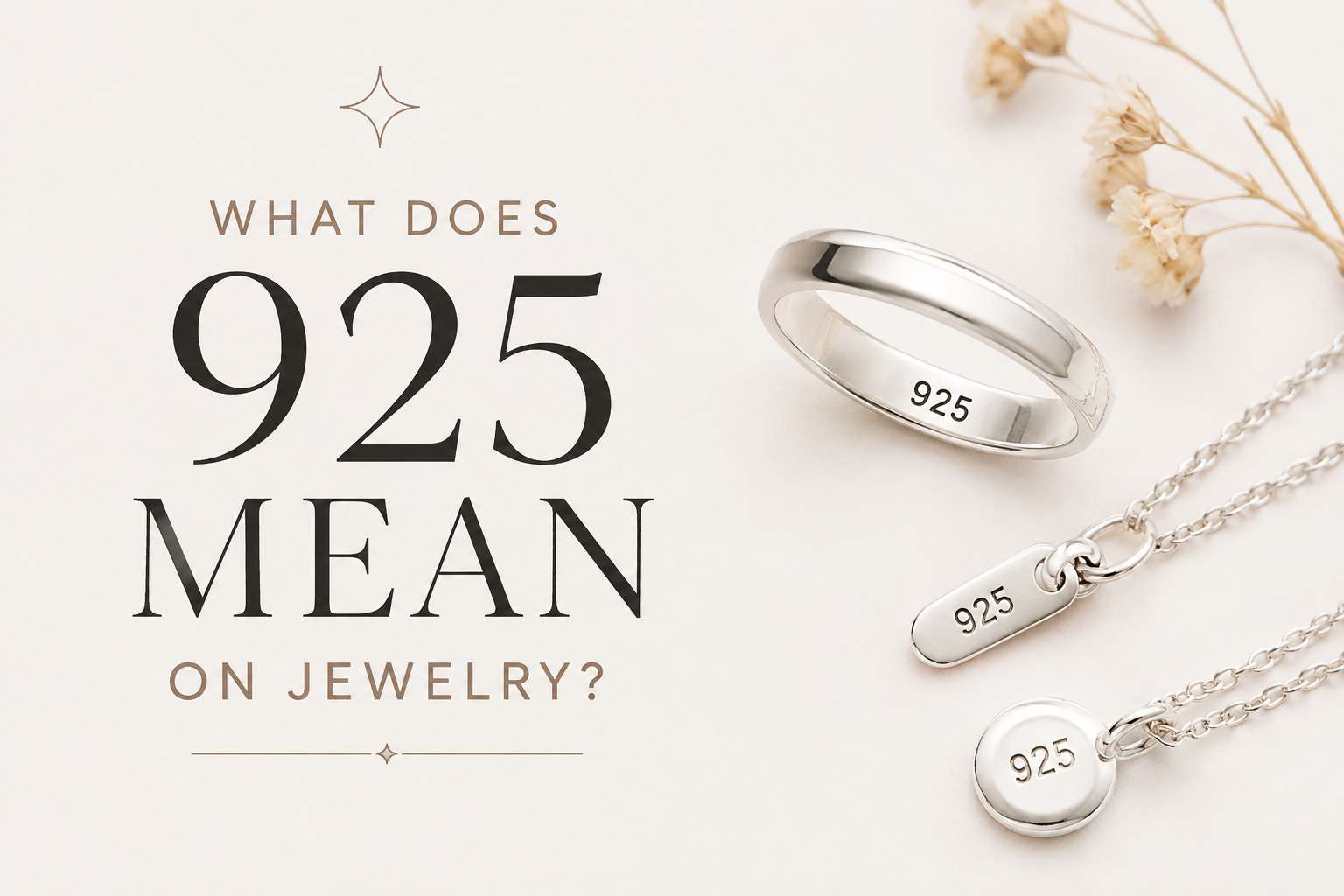
If you see 925 stamped on jewelry, it means the metal is marked as 92.5% silver by fineness. The remaining 7.5% is made up of other metals, commonly copper, to create a stronger alloy suitable for jewelry.
This is commonly known as 925 sterling silver. The number 925 refers to 925 parts of silver per 1,000 parts of alloy. It does not refer to the item's weight, price, age, or quality level.
For retailers, importers, distributors, and other B2B buyers, there is one important distinction: a 925 stamp represents a claimed metal fineness. The stamp itself is not independent proof that the jewelry is genuine. Material specifications, supplier documentation, sampling, and appropriate testing may still matter when evaluating a wholesale order.
The easiest way to understand a 925 stamp is to read it as 925 parts per thousand.
| Mark | Silver content | Common description |
|---|---|---|
| 999 | 99.9% | Fine silver |
| 950 | 95.0% | High-fineness silver |
| 925 | 92.5% | Sterling silver |
| 900 | 90.0% | Coin silver in relevant marking systems |
| 800 | 80.0% | Lower-fineness silver |
In the United States, the FTC states that “silver,” “sterling,” and “sterling silver” describe products containing 92.5% pure silver, and that a 925 mark means 925 parts per thousand are pure silver. Requirements for marking and disclosure can differ by market, so B2B buyers should check the rules that apply in their destination country.
The number is therefore a fineness mark. It describes the proportion of precious metal in the alloy rather than the overall quality of the finished jewelry.
Pure or fine silver is typically represented by a fineness of 999 or higher. It contains very little alloying metal, but it is relatively soft and malleable.
That can be a disadvantage in products that need to hold their shape through regular handling and wear. Rings, chains, clasps, earrings, and detailed settings need an alloy with practical mechanical properties.
Sterling silver solves this by combining silver with other metals. The result contains less silver than 999 fine silver but is generally more practical for jewelry manufacturing and everyday use.
The important point is that 925 is not simply “less pure” in a negative sense. The alloy is deliberately formulated to balance silver content with the properties needed for jewelry production.
ISO 9202:2026, the current international standard for precious-metal alloy fineness, specifies recommended fineness ranges for precious-metal alloys used in jewelry and notes that national requirements for designation, marking, and stamping may also apply.
A 925 stamp can appear in several forms. The exact marking system can vary by market and manufacturer.
You may encounter:
The number is about metal fineness, not the total weight of the piece. A 10-gram item marked 925 does not contain 9.25 grams of silver automatically because the total product may include stones, findings, plating, solder, or other non-silver components. The 925 figure describes the fineness of the relevant alloy, not the complete product's retail weight.
The mark is often placed where it can be seen during inspection without dominating the design.
Common locations include:
The location can help you find the mark, but it does not authenticate the item by itself.
You may also see markings such as 925 Italy, 925 China, or 925 Thailand.
The key point is to separate fineness from origin.
The 925 portion relates to the claimed silver fineness. A country name or geographic reference can provide information about origin or manufacturing, depending on the marking system and applicable rules.
It should not be treated as a simple quality ranking.
For example, assuming that “925 Italy” is automatically higher quality than “925 China” confuses country of origin with material specification and manufacturing quality. The finished product can also vary in workmanship, construction, surface treatment, component quality, inspection, and other factors.
China has its own national requirements covering precious-metal jewelry fineness and designation. Buyers sourcing from China should therefore evaluate the actual product specification and applicable compliance requirements rather than using the country mark as a shortcut for quality.
For B2B sourcing, this distinction is especially important. A retailer comparing suppliers should evaluate the material claim, product construction, testing or documentation, workmanship, and consistency between samples and production batches.
A 925 stamp gives you useful information, but it does not answer every question about a piece of jewelry.
A legitimate 925 fineness mark indicates that the marked metal is represented as containing 92.5% silver by mass.
A 925 mark does not, by itself, tell you:
This is one of the most important points for wholesale buyers. Material fineness and overall product quality are related, but they are not the same thing.
A well-made 925 ring and a poorly finished 925 ring can carry the same fineness mark.
The main difference is silver content and the resulting alloy composition.
| Factor | 925 Sterling Silver | 999 Fine Silver |
|---|---|---|
| Silver fineness | 925/1000 | 999/1000 |
| Silver content | 92.5% | 99.9% |
| Other metals | 7.5% alloy | Very small amount |
| Relative softness | More suitable for jewelry use | Softer and more malleable |
| Common applications | Rings, chains, earrings, bracelets, pendants | Bullion, specialty pieces, selected jewelry |
| Main advantage | Balance of silver content and practical performance | Higher silver purity |
So, is 999 better than 925?
Not necessarily.
If the goal is maximum silver purity, 999 contains more silver. If the goal is practical jewelry production, 925 offers an alloy composition commonly used for wearable jewelry.
The correct choice depends on the product, design, intended use, market requirements, and buyer expectations.
A 925 stamp is a useful starting point, but serious buyers should avoid treating one small mark as conclusive evidence. Buyers evaluating silver jewelry should also consider the item's construction, finish, components, and available documentation rather than relying on the stamp alone. Our guide to choosing affordable silver jewelry covers these broader quality checks in more detail.
Look at the clarity and placement of the stamp.
Check whether the product description, packaging, supplier specification, and physical marking are consistent.
A poorly defined or unusual mark does not automatically mean the jewelry is fake, but it is a reason to investigate further.
A magnet test is sometimes used as an initial check because silver itself is not strongly magnetic.
However, this is only a screening method. It cannot prove that an item is 925 sterling silver.
Similarly, visual inspection and other simple home tests have limitations. Surface treatments, mixed components, solder, and construction can make simple tests difficult to interpret.
For higher-value purchases or wholesale orders where material claims are commercially important, professional testing can provide stronger evidence.
Modern analytical methods can determine silver content. For example, ISO 19919:2025 specifies an ICP-OES method for determining silver content in suitable materials, while ISO 15096:2020 covers determination of high-purity silver using an ICP-OES difference method.
The appropriate testing method depends on the material, product construction, required accuracy, and applicable market requirements.
For a B2B buyer, the practical lesson is simple:
Use the 925 stamp as one verification point, not the entire verification process.
For a consumer buying one necklace, a 925 stamp may answer most of the immediate material question.
For a retailer or importer placing a wholesale order, it is only the beginning.
Before approving a supplier, consider asking:
This approach is more reliable than comparing suppliers based only on a product title such as “925 silver jewelry.”
When evaluating a wholesale collection, buyers can also compare construction, finishing, clasps, stone settings, dimensions, packaging, and other product specifications alongside the silver claim. For businesses building a retail assortment, these details can matter as much as the fineness mark.
For buyers looking for a broader selection, Yaolu's wholesale silver jewelry collection currently includes a range of jewelry listings, making the category a useful starting point for comparing styles and product specifications.
Yes.
A jewelry item can use 925 sterling silver as its underlying metal and have a gold-colored surface applied through plating.
This is why a piece can be described as gold-plated sterling silver while still carrying a 925 mark.
The important distinction is:
Do not assume that a 925 mark means the entire visible surface is untreated silver.
Vermeil is one specific example: the FTC describes vermeil as sterling silver coated or plated with gold, subject to additional requirements in its Jewelry Guides.
For wholesale sourcing, buyers should therefore ask separately about the base metal, surface treatment, and plating specification.
No.
925 sterling silver is a silver alloy with a claimed fineness of 925 parts per thousand.
Silver-plated jewelry uses another base material with a layer of silver applied to its surface.
That difference matters when comparing supplier specifications, product descriptions, pricing, and expected product characteristics.
The FTC also distinguishes silver products from silver-plated products and cautions against representing coated products as solid silver without appropriate qualification.
For a detailed comparison, this topic is best handled in a dedicated silver-versus-silver-plated guide rather than repeating the full discussion here.
No.
A 925 stamp is a fineness claim. It does not independently prove that the metal actually contains 92.5% silver.
For ordinary purchases, the mark is a useful indicator. For higher-value or wholesale transactions, buyers should also consider supplier documentation, sample inspection, and appropriate material testing.
“925 Italy” generally combines a 925 silver-fineness indication with an Italy-related origin or manufacturing marking.
The 925 refers to silver fineness. The country reference should not be interpreted as a standalone grade of overall jewelry quality.
When sourcing internationally, evaluate the material specification, workmanship, compliance requirements, and supplier documentation rather than assuming that one country mark guarantees superior quality.
“925 China” can indicate a 925 silver-fineness marking associated with jewelry from China.
The presence of “China” does not, by itself, establish that the jewelry is lower quality. Likewise, a country name alone does not prove superior quality.
For B2B buyers, the more useful questions are whether the product meets the specified silver fineness, whether the construction matches the agreed specification, and whether the required testing and documentation are available.
Yes, 925 silver has material value because it contains a substantial proportion of silver.
However, the value of finished jewelry is not determined by silver content alone. Weight, design, craftsmanship, gemstones, brand, condition, market demand, and other factors can affect the price.
A 925 stamp should therefore not be treated as a guarantee of a particular retail or resale value.
Yes. Sterling silver is widely used for everyday jewelry.
Regular wear can expose silver to moisture, chemicals, cosmetics, friction, and air, which can contribute to tarnishing or surface wear. Retailers can also direct customers to practical guidance on cleaning tarnished jewelry safely.
For retailers, explaining basic care to customers can help reduce avoidable complaints and protect the appearance of products after purchase.
What does 925 mean on jewelry? It means the marked silver alloy has a fineness of 925 parts per 1,000, or 92.5% silver, with the balance made up of other alloying metals.
The important distinction is that 925 describes silver fineness, not the complete quality of a jewelry product.
For consumers, the mark is a useful starting point when identifying sterling silver. For B2B buyers, it should be one part of a broader sourcing checklist that includes material specifications, construction, finishing, supplier information, applicable marking requirements, and appropriate verification.
Understanding that difference helps retailers and importers make better comparisons when evaluating 925 silver jewelry and building a dependable wholesale collection.
If you see 925 stamped on jewelry, it means the metal is marked as 92.5% silver by fineness. The remaining 7.5% is ma
READ FULLWhite gold and silver can look very similar, especially when both have a polished or rhodium-plated finish. However,
READ FULLTranish looks bad, but it rarely means your jewelry is ruined. In most cases, you can fix it at home in under ten min
READ FULL