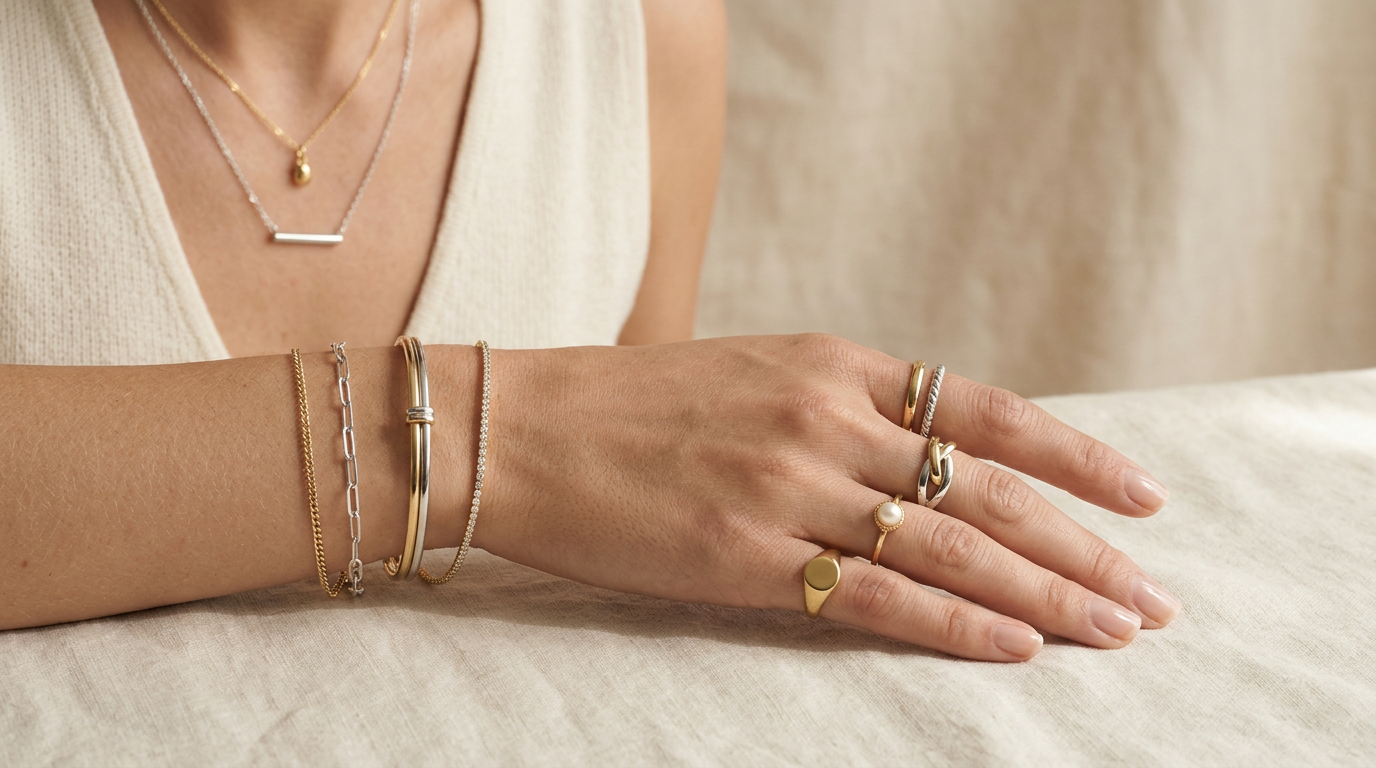
Yes — wearing gold and silver together is not a styling mistake. The idea that you have to commit to one metal came from an era when jewelry was sold and worn as matching sets. That's no longer how most people build a collection, and mixing gold and silver is now one of the simplest ways to get more use out of the pieces you already own.
This guide skips the general "mixing is fine" advice and focuses on what actually trips people up: when the combination looks intentional versus accidental, why some mixed-metal looks read as cheap, and how to build toward it without replacing half your jewelry box.
Gold and silver read differently to the eye. Gold has warmth and sits closer to skin tone, so it tends to blend in. Silver is cooler and brighter, so it stands out more against most complexions. Worn separately, each metal does its own thing. Worn together, the warmer and cooler tones create contrast — the same principle that makes a warm-toned outfit look sharper with one cool accent, or a monochrome look land better with a single accent color.
That contrast is also why a piece that already combines both metals — a two-tone watch, a ring with a gold band and silver detailing — tends to look more finished than an outfit with only one metal. It's not that gold or silver alone looks worse; it's that two tones give the eye more to register, and that reads as more deliberate styling.
Most of the resistance to mixing gold and silver comes down to three specific worries, not a general dislike of the look.
No. Gold and silver don't react with each other, so wearing them together won't cause corrosion or discoloration on either piece. If your silver tarnishes, it's from exposure to air, moisture, sweat, or sulfur-containing products (like some lotions or hairspray) — not from contact with gold.
What actually helps: store silver pieces in an anti-tarnish pouch or a sealed bag when you're not wearing them, and give them a quick wipe with a soft cloth after a day of wear, especially if you've been sweating or swimming. This has nothing to do with mixing metals — it's just how silver behaves on its own, and it matters more once you're wearing it daily as part of a stack.
When a mixed-metal look does read as cheap, it's almost never the mixing itself. It's usually one of two things:
The fix isn't avoiding the mix — it's paying attention to condition and finish before you pair pieces. Two well-kept pieces in different metals will always look more coordinated than two pieces in the same metal where one is worn down.
Not as a rule, but it can be a useful starting point if you're unsure where to begin. Gold tends to look warmer against skin with golden or olive undertones, while silver often reads brighter against cooler, pink-toned skin. This is a preference guide, not a restriction — plenty of people wear both metals regardless of undertone and it looks fine. If you want a simple starting point: hold a gold piece and a silver piece against your wrist in natural light and see which one you reach for first. That's usually your lead metal, covered next.
Three habits separate a mix that looks planned from one that looks accidental.
Decide which metal makes up most of your look, and let the second metal show up in smaller amounts — an accent ring, one earring style, a slim bracelet. A 70/30 split reads as intentional. A 50/50 split, where both metals compete equally, tends to read as indecisive. This is the single most useful rule if you only take away one thing from this guide.
A single silver ring surrounded by gold jewelry looks like an outlier — as if you forgot to take it off. The same silver tone showing up twice (a ring and an earring, or a bracelet and a necklace clasp) reads as a choice rather than an oversight. This is a small detail, but it's the difference between "styled" and "mismatched."
This is where most guides stop at "match the colors" and miss the bigger factor: two pieces of similar chain thickness, similar polish, or similar level of detail will always sit together better than two pieces that are just the same metal family. A delicate gold chain next to a chunky silver cuff can clash even though both are precious metal — the mismatch is in weight and finish, not color. When picking pieces to pair, look at scale and texture first, metal color second.
Necklaces: Layer at different lengths so each chain has its own space. A shorter gold chain near the collarbone with a longer silver pendant avoids the two metals overlapping at the same point, which is what usually causes visual clutter.
Rings: Hands are the most forgiving place to mix, since natural hand movement already breaks up symmetry. Split gold and silver rings across different fingers, or stack them on the same finger if you want a tighter, more layered look.
Bracelets: Vary the shape, not just the metal — a structured gold bangle next to a fine silver chain bracelet reads balanced almost immediately, because the difference in form does most of the visual work.
Earrings: This is the one area where matching matters more, since earrings sit close to the face and asymmetry draws attention fast. Either repeat both metals in each ear, or choose one two-tone earring style as your anchor and build the rest of your accessories around it.
Watches: A watch with both metals in the case and band effectively does the mixing for you, and makes everything else you're wearing look coordinated by association.
You don't need to buy a whole new set to start mixing metals — this is worth saying plainly, because most guides skip straight to "here's how to style it" and assume you already own five pieces in each tone.
A single piece that combines both metals — a two-tone ring, a chain with a gold clasp on a silver base — does the visual work of connecting your existing gold and silver items without requiring you to buy anything else in either tone. It's the lowest-effort way to test whether you like the mixed look before committing further.
Most people already have at least one piece in each metal, even if they've never worn them together — a childhood gift, a hand-me-down ring, an old watch. Before buying anything new, lay out what you have and try one small pairing: one gold piece, one silver piece, nothing else. If it's a silver jewelry piece you already like the shape of, it's often easier to add a gold accent to it than to plan a whole new stack from scratch.
Everyday: Keep the mix to two or three pieces total — a chain, a ring, small studs. The goal is that it looks like part of your regular routine, not a deliberate styling choice you thought about that morning.
Work: Lean toward one dominant piece per metal rather than layering multiple items in each. A two-tone watch plus a single necklace above the neckline reads polished without looking busy next to structured clothing.
Evening: This is where more contrast works in your favor. A brighter silver piece next to a warmer gold one catches light differently under evening lighting, which is more noticeable — and more flattering — than it would be in daylight.
Is mixed-metal jewelry okay for everyday wear?
Yes. Keeping the mix to two or three pieces — rather than a full stack in each metal — is what makes it practical for daily wear rather than something reserved for going out.
Can I wear my gold wedding ring with silver jewelry?
Yes, and you don't need to plan around it. A wedding ring can simply act as your lead gold piece, with silver pieces elsewhere on your hands, wrists, or ears playing the supporting role. There's no rule that sentimental pieces need to match everything else you wear.
Can yellow gold, white gold, and rose gold all mix with silver at once?
They can, but it's easier to manage if you treat white gold and silver as one tone group, since they're close enough in color that they read as coordinated by default. Add yellow or rose gold as the contrast piece rather than trying to balance three or four different tones evenly, which is where a mix can start to look cluttered.
Yes — wearing gold and silver together is not a styling mistake. The idea that you have to commit to one metal
READ FULLCultural souvenir prod
READ FULL