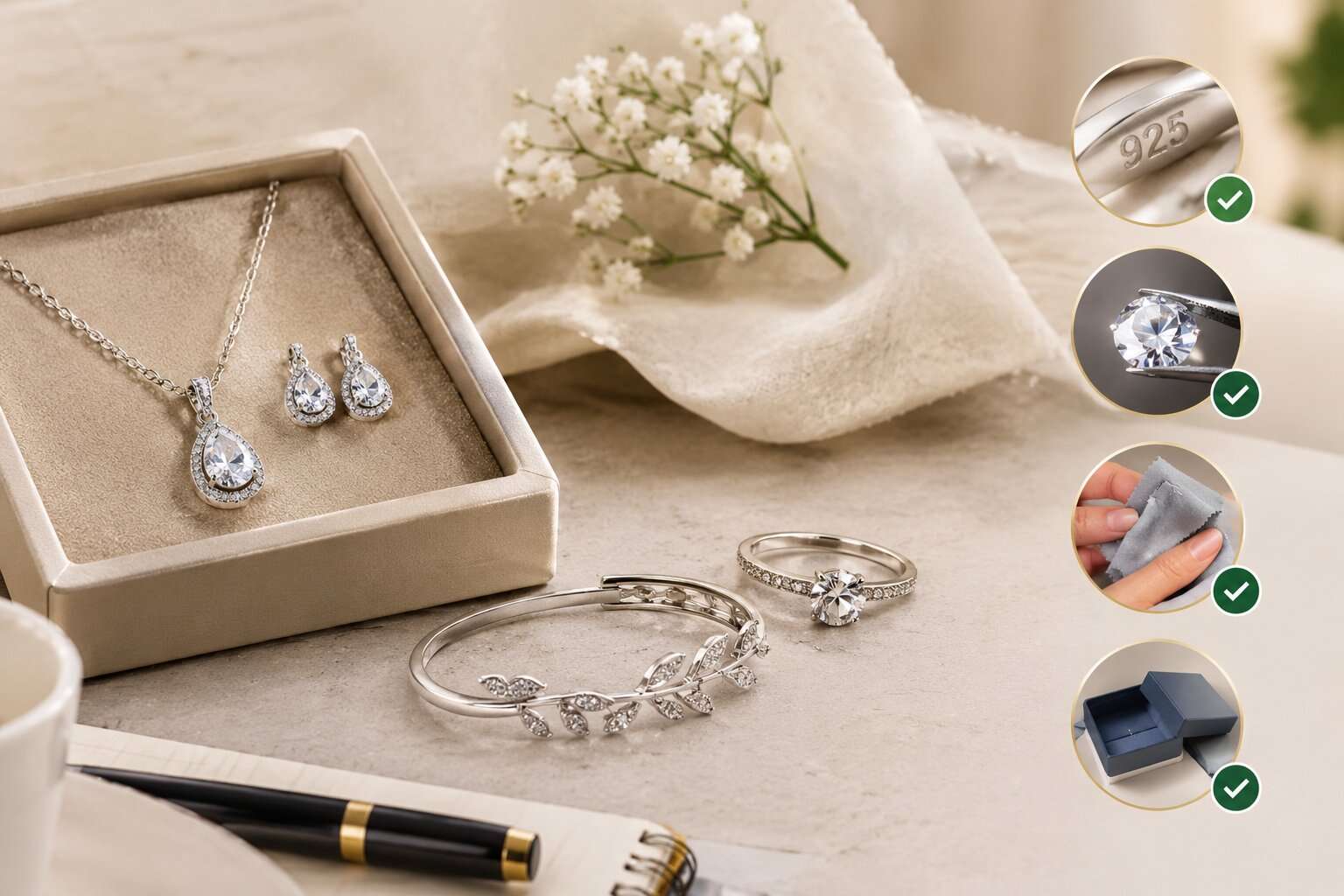
Silver looks the same on a shop shelf whether it is sterling, plated brass or something in between. That is why checking before you pay matters more than choosing the design. We supply sterling, plated and gold-plated pieces through our silver jewellery range, and the same checks apply whether you are buying one ring or stocking a shop.
Here is what to check, in the order that saves the most money.
The 60-second check
The word “silver” on a tag describes a colour as often as a material. These are the materials you will actually meet:
| Material | What it is | What to know |
|---|---|---|
| Fine silver (999) | 99.9% silver | Very soft. Scratches and bends easily, so it suits few everyday designs |
| Sterling silver (925) | 92.5% silver, 7.5% other metals, usually copper | The standard for jewellery. Durable, but it tarnishes |
| 800 / 835 silver | Lower silver content | Valid grades, but the price should reflect the extra alloy |
| Silver-plated | A thin silver layer over base metal such as brass | Wears through with use. No meaningful resale value |
| Gold-plated silver | A gold layer over a silver base | The label doesn’t tell you the base is 925. Ask |
| Rhodium-plated 925 | Sterling with a hard, bright protective coat | Resists tarnish until the coating wears |
| Nickel or “German” silver | Copper-nickel-zinc alloy | Contains no silver at all |
Oxidised silver is a finish, not a metal. Jewellers darken silver on purpose to bring out engraving and texture. That finish can sit on genuine sterling, but cheap costume pieces use it on brass too. The finish tells you nothing about the metal underneath, so check the hallmark.
A “925” stamp is a claim. A hallmark applied by an independent testing body is evidence. Learn the difference for your market.
India. Silver hallmarking is voluntary. Hallmarking with a unique ID (HUID) has been available since 1 September 2025 under the revised standard IS 2112:2025. A hallmarked piece should carry three things: the BIS mark with the word “SILVER,” a purity grade, and a six-character HUID. The grades are 800, 835, 925, 958, 970, 990 and 999.
You can verify the HUID yourself:
Two more practical points from BIS guidance. Each item of a pair (and each detachable part) should carry its own HUID. Jewellers are also expected to keep a 10X magnifier so you can see the mark. The rules are recent, so check bis.gov.in for current requirements.
United Kingdom. A UK hallmark has three compulsory marks: the maker’s or sponsor’s mark, the fineness mark (925 for sterling) and the assay office mark. Silver items under 7.78 grams are exempt, so a missing hallmark on a light earring is not proof of a fake.
United States. There is no assay-office system. The FTC’s consumer guide on buying platinum, gold and silver jewellery explains the terms sellers may use.
What a hallmark cannot tell you:
A good seller answers purity questions in specifics. Before you pay in a shop, check that the bill shows:
Buying online? The product page should state the purity and weight, name the plating type (if any), and say what any stones are. Ask for a clear photo of the hallmark. A vague phrase like “high-quality silver” is a reason to ask more questions. Read the return window before you order.
Sourcing stock for a shop? Ask for samples and for the material of each design, and ask what test documentation exists for the pieces you want. We arrange samples before bulk orders and confirm the material per design. You can request a sample and the material details for the styles you are considering.
A silver price has two parts: the metal and the making. Split them before you compare offers:
Price = weight × purity × silver rate + making charge + tax
Here is an illustration, using a round rate of ₹250 per gram of fine silver (about where Indian rates sat in late October 2026). Check the live rate before you shop.
Three things follow from this:
Silver rates also move daily. Indian market rates fell about 4% between 1 and 21 October 2026, so a price quoted last week may not hold. Ask which day’s rate the quote uses.
Different pieces fail in different places. Check the weak point for the item you are buying:
| Piece | Where it usually fails | What to check |
|---|---|---|
| Chains and necklaces | Clasps, jump rings, thin links | The clasp should snap firmly. Rings in the chain should be closed. Fine cable chains tend to stretch and break sooner than box or rope chains |
| Bangles and bracelets | Dents in hollow construction | Ask for the weight. A bangle that feels hollow for its size may hold less silver than it appears to |
| Rings | Thin bands, resizing limits | Look at the band’s thickness at the back. Patterned, stone-set and eternity bands are hard or impossible to resize |
| Earrings | Loose backs, thin posts | Check the post thickness and how securely the back grips. Ears are also where plating and nickel reactions show first |
| Anklets | Constant friction and knocks | Check the joints and any attached bells or charms |
| Stone-set pieces | Loose or glued stones | Prongs should be smooth and even. Ask whether the stones are natural, lab-grown, cubic zirconia or glass |
For daily wear, solid sterling in a simple design lasts longest. Plated and gold-plated pieces suit occasional wear, because the coating thins with friction, sweat and cosmetics. For finishes, proportions and styling, see our guide to choosing silver pieces that look more expensive than they are.
Buyers often treat these as one problem. They are not.
Tarnish is silver reacting with sulfur compounds in the air and on skin. The copper in sterling speeds it up, and humid weather and sweat make it worse. Tarnish does not mean the piece is fake, and polishing removes it.
Green or black marks on skin come from copper, or from the base metal under a plated piece, forming salts on contact with skin. They are harmless and depend on your skin chemistry, sweat and the products you wear. If a piece sold as silver marks your skin within days, suspect worn plating or a base-metal core.
Allergic reactions are a different thing. Nickel allergy causes redness, itching or a rash. Sterling’s usual alloy metal is copper, but alloys vary by maker, so ask whether a piece is nickel-free. Rhodium plating adds a barrier, but it wears off with use. If you have reacted to jewellery before, buy one small piece first and check the return policy. If a rash persists, see a doctor.
| Test | What it can tell you | Limit |
|---|---|---|
| Magnet | Rules out iron and steel | Brass, pewter and nickel silver are non-magnetic and pass |
| Ice melt | Silver conducts heat well, so ice melts quickly | A copper core under thick plating can pass |
| Ping (sound) | Little | Unreliable on its own |
| Acid test kit | The most reliable home method | Marks the surface, so use an inconspicuous spot |
| XRF at a jeweller | Fast, non-destructive composition reading | Needs a jeweller or lab with the equipment |
Use the magnet to rule things out, not to confirm silver. For anything you are paying real money for, rely on the hallmark plus a jeweller’s test.
Expect silver to darken, and plan for it:
Is 925 silver pure silver?
No. It is 92.5% silver, with 7.5% other metals added for strength. Pure (fine) silver is 99.9% and too soft for most jewellery.
Is oxidised silver real silver?
It can be. Oxidising is a darkening finish, so the hallmark is the only way to know what metal sits underneath.
Can I trust a 925 stamp by itself?
Treat it as a claim, not proof. Stamps can be faked, so look for a hallmark from a testing body, a seller’s written purity statement and a bill that matches.
How much are making charges on silver jewellery?
They are often quoted at 10–25% and vary by design and seller. Compare the charge per gram between shops, and get it listed as its own line.
Is it safe to buy silver jewellery online?
Yes, if the listing states the purity and weight, shows the hallmark, names any plating, and comes with a clear return window.
Silver looks the same on a shop shelf whether it is sterling, plated brass or something in between. That is why check
READ FULLA stand collar can sit well on one customer and choke another. A “linen” tag can hide a fiber that shrink
READ FULLFrog buttons are the knotted loop-and-button closures known in Chinese as pankou (盘扣). A pankou is made of two pa
READ FULL