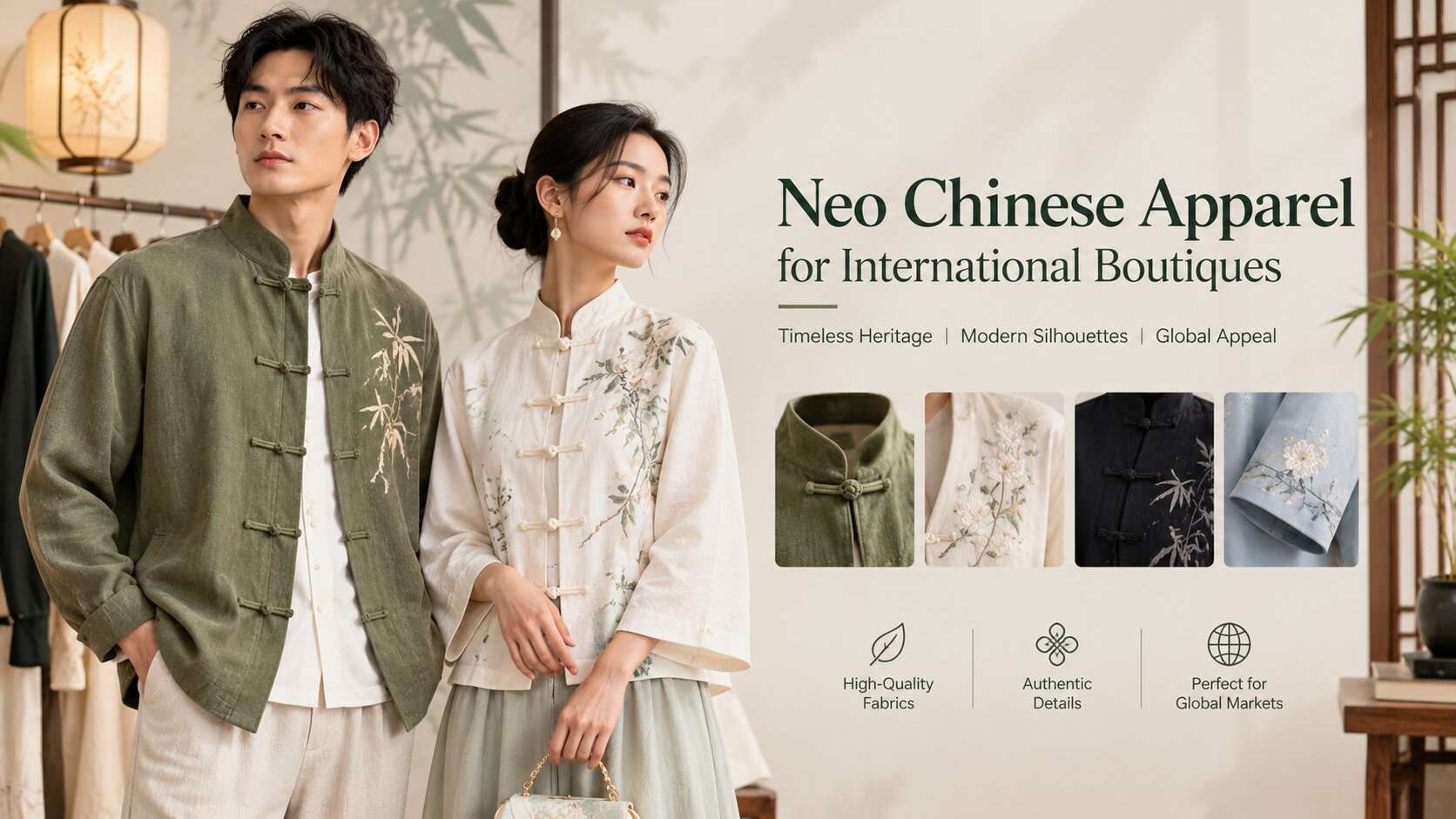
A stand collar can sit well on one customer and choke another. A “linen” tag can hide a fiber that shrinks in the first wash. A factory quote can look healthy until freight and duties are added. Those three problems cost boutiques more money on neo-Chinese apparel than any trend miss.
This guide covers how to judge the design, fabric, fit and quality of neo-Chinese pieces, where to source them, and how to calculate what they cost by the time they reach your shelf.
Buyers meet three overlapping categories. Mixing them up leads to wrong supplier searches and wrong customer expectations.
| Category | Core idea | Typical wearer | Buying implication |
|---|---|---|---|
| Traditional (hanfu, formal qipao, Tang suit) | Historical or ceremonial silhouettes | Cultural events, weddings, festivals | Occasion stock; fit and authenticity matter most |
| Neo-Chinese (新中式, “New Chinese Style”) | Traditional details reworked into daily wear | Everyday shoppers, diaspora and culture-curious customers | Easiest to merchandise next to Western-cut stock |
| Chinese-inspired (Western label) | One motif borrowed for a seasonal line | Mainstream fashion shoppers | Not a sourcing category; no consistent construction |
You will also see “Guochao” in Chinese-market coverage. It refers to the broader wave of pride in domestic design. Supplier catalogs more often use “new Chinese style,” “Mandarin-collar” or “improved hanfu.” Search all of them.
Most growth figures describe China’s own market. Industry estimates put Chinese-style apparel at 200 to 300 billion yuan. That shows the design language sells at scale at home. It doesn’t tell you what a boutique in Toronto or Lisbon will sell in March.
Overseas buyers usually fall into three groups:
The safest approach for most boutiques is a capsule inside the existing assortment. A capsule is a defined group of pieces, not a full change of identity. Trend analysts describe the crossover pieces as neo-Tang jackets worn as blazers and shorter neo-qipao cuts in stretch or sheer fabrics. Both borrow one signature detail and keep the rest familiar.
Many suppliers attach “Chinese style” to a Western pattern with a printed motif. Real neo-Chinese design shows up in construction. Check these six details first.
Collar. The Mandarin (stand) collar is the most recognizable signal. Ask for the collar height and whether it is fused or soft. A collar that is too tall or stiff is the first thing Western customers complain about.
Closure. Pankou (frog buttons) are knotted loop-and-button closures. Some close the garment and some sit over a hidden snap or zipper. The product page should say which. For types, hand versus machine work and sourcing specs, see this guide to pankou construction and types.
Placket direction. Traditional garments for the living overlap right over left, with the placket running diagonally from collar to underarm. A mirrored placket looks wrong to customers who know the tradition. Confirm the direction on the sample.
Cut. Neo-Chinese pieces are usually looser than classic qipao. Straight or dropped shoulders, relaxed sleeves and side slits are common. This makes them easier to fit across body types.
Trim. Bias binding (滚边), piping and fabric-covered knots separate considered design from a printed imitation.
Pattern. Cloud, floral, bamboo and calligraphic motifs work when they are woven, embroidered or printed with intent. Placed at random, they read as decoration.
Start with the pieces that need the least explanation.
| Style | Why it works | Buying note |
|---|---|---|
| Stand-collar shirts and blouses | Easy to style with denim or tailoring | Lowest fit risk; best first buy |
| Slant-placket tops and light jackets | Clear cultural signal, still wearable daily | Check placket direction and drape |
| Padded or fleece-lined coats | Autumn–winter layering with pankou detail | Heavier fabric strains closures; inspect attachment |
| Wide-leg trousers | Pairs with the tops above | Specify rise and inseam, not just S/M/L |
| Vests and waistcoats | Low-price add-on, easy layering | Good entry price point |
| Neo-qipao dresses | Strong visual impact | Higher fit risk; test with fit models |
| Mamianqun skirts, pao robes | Specialist appeal | Order small unless your customer base already asks |
As an example of a range built this way, Yaolu’s Neo-Chinese linen and cotton apparel series covers thin shirts, fleece-lined coats, vests and wide-leg trousers. It keeps frog buttons and slant plackets inside looser daily silhouettes.
Fabric decides how a garment drapes, how it wrinkles and how it holds up.
Linen. It breathes well in heat and wrinkles easily. Customers who buy linen expect creasing, but pieces still need to look intentional. Ask about garment washing, which softens the hand and reduces later shrinkage.
Cotton. It holds shape better and washes predictably at scale. It suits structured pieces such as shirts with fused collars.
Cotton-linen blends. They balance airflow and durability and often suit boutique stock best. For a deeper comparison, see how cotton-linen compares with other fabrics.
Silk and satin. They dominate formal and occasion pieces. Price follows fabric and embroidery hours far more than silhouette, so two garments that look alike can cost ten times as much depending on materials and embroidery.
Asian size charts rarely map cleanly to US, UK or EU sizing. Layered or tied garments also size differently from fitted ones. Customers between sizes often do better sizing up in these styles, because a looser layer reads better than a tight one.
Do not accept S/M/L alone. Ask the supplier for flat garment measurements in cm:
Compare those numbers with your own best-selling pieces and keep a short conversion sheet. Record the measurements you actually receive on samples. If they differ from the spec, the next order should say so.
Order samples first. Then inspect these points on every sample:
Each channel behaves differently.
| Channel | Typical strengths | Typical limits |
|---|---|---|
| Independent designer brands | Original design, strong storytelling | Higher prices, limited quantities, exclusivity rules |
| Factories (OEM/ODM) | Lower unit cost, customization | Higher per-style MOQs, tech pack expected |
| Wholesale markets (Guangzhou, Shenzhen, Hangzhou) | Low per-style quantities, quick decisions | Limited export help, English support varies |
| B2B platforms | Wide supplier choice | Uneven quality and verification |
| Trading companies | One point of contact across several makers | Depends on the quality of its supplier network |
MOQs differ by channel because the economics differ. Reported market minimums run from a few pieces per style. Factory minimums commonly run in the hundreds per style and color. If a quote seems too good, ask what MOQ and which fabric it assumes.
A trading company can suit a boutique that wants several styles from specialist makers without managing each relationship. Yaolu operates as a trading company and sources from manufacturers in this niche. Whichever channel you choose, ask who actually makes the garment.
A first order should answer questions, not maximize volume.
Start with a small capsule, such as 6–10 styles. Choose styles from different rows of the table above.
Limit colors. Two or three per style is enough to read demand.
Buy a curve of sizes that reflects your customers, not an even split.
Order samples for every style and test them before committing.
Agree on lead times and reorder windows before the first order. Ask how long a style stays in production and what the reorder minimum is.
Plan around Lunar New Year. In 2027 it falls on 6 February, and Chinese factories typically slow down for weeks around it. Orders for spring stock should be placed well before that.
For women’s lines beyond this niche, you can check the wider women’s apparel lines for trousers, tops and layering pieces to round out the capsule.
The quoted unit price is only the start. Your landed cost includes:
FOB or EXW price per unit
International freight and insurance
Import duty
Customs brokerage and clearance fees
Domestic delivery
Duty depends on your destination, the HS/HTS code and the garment’s fiber and construction (knit or woven). US tariffs on Chinese apparel changed several times in 2025–2026. Trackers show a stack of the base rate, an existing China-specific duty and a Section 301 forced-labor duty that took effect on 24 July 2026. Published combined rates still differ between sources. Confirm the current rate for each style with your customs broker or an official tariff database before you price.
Illustrative example only; the duty rate here is assumed, not current.
Item Per unit
FOB price $18.00
Freight and insurance (allocated) $1.50
Duty at an assumed 30% of $18.00 $5.40
Brokerage and clearance (allocated) $0.60
Landed cost $25.50
Many boutiques price at roughly 2 to 2.5 times landed cost. On this example, that points to a retail price around $51 to $64. If duties rise, either the retail price rises or your margin shrinks. Run the numbers per style before you place the order, and keep a buffer for rate changes.
Basic checks apply to any Chinese supplier: business license, factory photos, references, and staged payments or a protected payment method. For neo-Chinese apparel, add these:
Ask for close-up photos of pankou, collars and embroidery on actual production, not catalog shots.
Ask which parts are made in-house and which are outsourced.
Ask whether the design is original or copied from a named designer. Copies of independent designers’ work create legal and reputational risk for your boutique.
Request composition details and wash-test results for each style.
Check how they handle size charts, revisions and reorders.
A supplier that answers these questions specifically is usually a better partner than one that answers generically.
Customers notice careless labeling. Use accurate names (pankou, Mandarin collar, slant placket) and describe what the piece is. Avoid “Oriental” or vague “Asian-inspired” copy.
Be careful with motifs. Dragon and phoenix imagery, colors such as red and gold, and ceremonial garments carry specific meanings. Industry commentators have also warned that Western brands risk cultural appropriation when they borrow Chinese elements carelessly. Tell the story of a piece accurately, and avoid claiming symbolism you can’t verify.
Neo-Chinese pieces sell best when shown as daily wear, not costume.
Style a stand-collar shirt with denim or tailored trousers.
Group by season. Linen and cotton suit spring and summer. Fleece-lined and padded pieces suit autumn and winter.
Keep one or two statement pieces and surround them with easy basics.
Put a short care and fabric note on the hangtag or product page.
Time a small Lunar New Year feature, but don’t depend on it for the whole capsule.
For a range centered on cotton and linen Mandarin-collar styles, the cotton and linen mandarin-collar range is the closest match to the capsule approach described here.
Send this with your first inquiry.
Style names or photos, and target quantities per style and color
Fabric composition and weight, with swatches if possible
Size chart with flat measurements
Collar height, placket direction and closure type
Sample cost, sample lead time and bulk lead time
MOQ per style, per color, and for mixed orders
Packaging, labeling and hangtag requirements
Shipping terms (FOB, EXW or other) and port
Compliance documents your market requires
Payment terms
What is a realistic MOQ for neo Chinese clothing?
It depends on the channel. Wholesale markets often accept small quantities per style. Factories usually ask for far more per style and color. Ask each supplier what its MOQ assumes.
Do these styles fit non-Asian customers?
Many do, especially looser shirts, jackets and trousers. Fitted qipao-style dresses carry more risk. Check flat measurements and test samples.
What is the difference between neo-Chinese and hanfu?
Hanfu refers to historical Han-style clothing. Neo-Chinese pieces borrow details such as collars, closures and plackets and turn them into modern daily wear.
How much should I order first?
Start with a small capsule across a few styles and limited colors. Use sell-through data to guide reorders.
Can I get customization at low volume?
Sometimes, on selected styles. Ask what can change (color, pattern, trims) and what the MOQ becomes.
Neo-Chinese apparel sells when the details are right and the economics hold. Choose pieces that cross over easily, check construction on real samples, size from measurements, and calculate landed cost before you commit. Then reorder from what actually sells.
Silver looks the same on a shop shelf whether it is sterling, plated brass or something in between. That is why check
READ FULLA stand collar can sit well on one customer and choke another. A “linen” tag can hide a fiber that shrink
READ FULLFrog buttons are the knotted loop-and-button closures known in Chinese as pankou (盘扣). A pankou is made of two pa
READ FULL