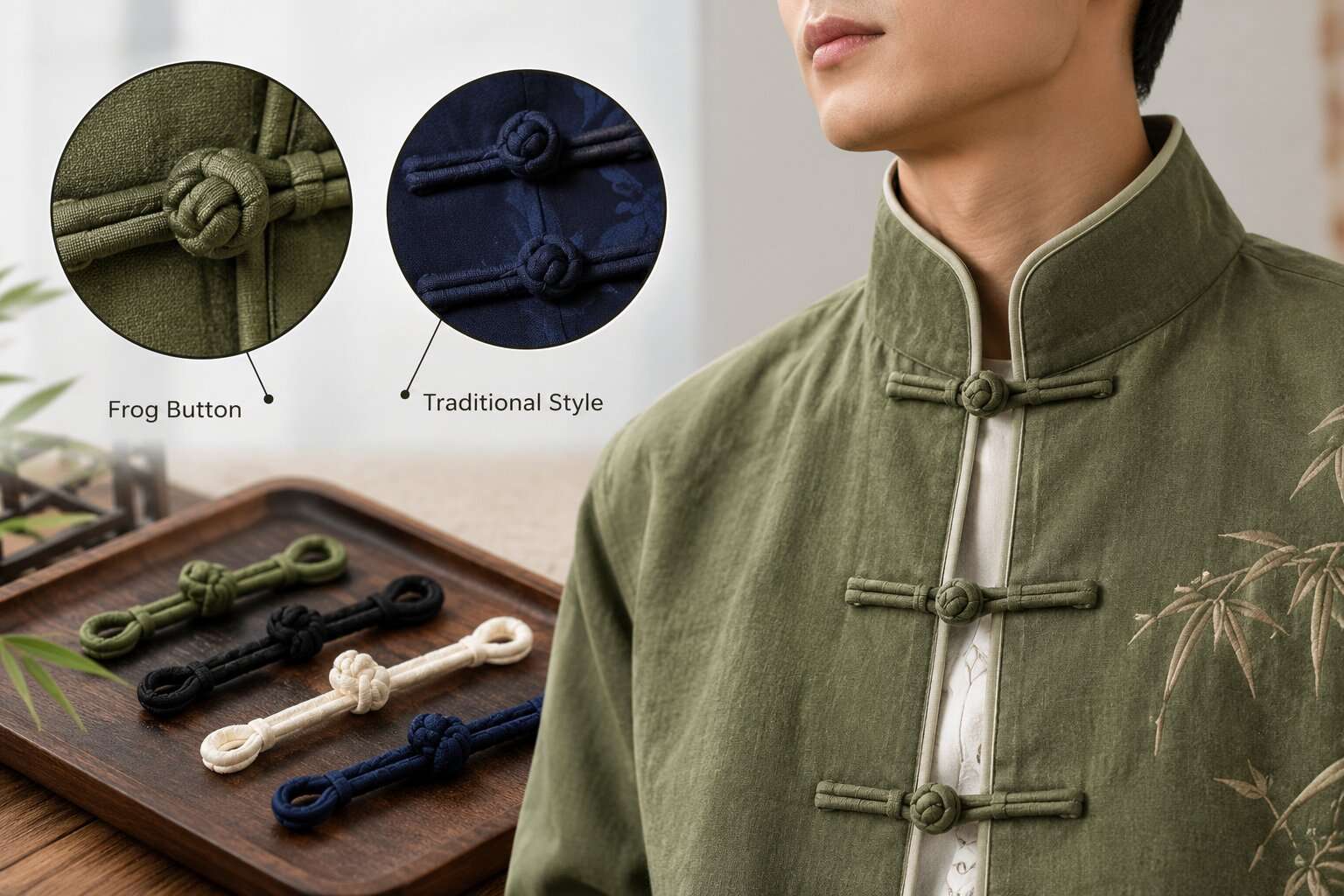
Frog buttons are the knotted loop-and-button closures known in Chinese as pankou (盘扣). A pankou is made of two parts, a decorative knot and a loop, and does two jobs at once. It holds the garment closed, and it is often the most visible ornament on the piece.
This guide covers how pankou are built, the main types, how designers decide where and how many to use, and how they behave on garments from qipao to modern jackets. It also covers the production details that separate a clean closure from one that puckers or sags.
A pankou has two sides. A knot, usually a Chinese button knot, sits on one edge of the opening. A loop sits on the opposite edge, and the knot passes through it to close the garment. The Chinese tradition treats the knot as the male element and the loop as the female.
The body of the closure is usually a narrow tube of fabric, braided cord, or covered wire. A tailor cuts a strip of fabric on the bias, at 45 degrees to the grain, and stitches it into a tube. The bias cut lets the tube bend smoothly around tight curves. That is why a good pankou can coil into a flower without kinking.
Makers often fill the tube with cord or wire. The filling holds the shape. Pankou from Zhoushan in Zhejiang, recognised locally as intangible cultural heritage, have traditionally used silk or satin wrapped around a stiffening core such as copper. Soft, unfilled tubing makes a good loop but cannot hold a petal or a wing.
Many Western sources call this closure a frog. The English word also covers cord-and-toggle fastenings on European military coats, which developed separately. For clear communication in sourcing and product copy, “pankou” is the unambiguous term.
The origin story varies from one source to the next. Some credit the Han dynasty, others the Tang, and Wikipedia says the loop-and-knot form existed by at least the Song, when braided buckles formed the loop and knot. Wikipedia also points to interlocking metal fasteners from the Ming dynasty as a precursor of the fabric version.
The safe reading is this. Chinese knotting has a very long history. The fabric pankou as a garment closure is documented from the Song onward, and it became closely identified with the qipao in the late Qing and Republic periods. Treat claims of a precise founding date with caution.
“Tang suit” (唐装) is a later label. It bundles the mandarin collar, frog buttons, and traditional motifs into one celebratory silhouette, and it became a popular term around the turn of this century. It does not mean the garment dates from the Tang dynasty.
The simplest division is between the plain closure and the ornamental one. Everything else is a variation on the shape of the loop and the form of the knot.
| Type | Chinese Name | What It Looks Like | Typical Use |
|---|---|---|---|
| Straight | 直盘扣 (also 一字扣) | A knot on one side, a plain loop on the other, no added ornament | Most modern qipao, jackets, shirts |
| Floral | 襻花盘扣 | The loop or knot side is coiled into flowers, leaves, or other shapes | Collar corners, chest accents, formal wear |
| Butterfly | 蝴蝶扣 | A floral type shaped like a butterfly | Decorative accent pieces |
| Pipa | 琵琶扣 | A floral type shaped after the lute; some English sources call it “kumquat” | Qipao fronts and collars |
| Phoenix Tail | 凤尾扣 | A floral type, widely used for bridal qipao | Wedding garments |
| Bead or Ball Substitute | N/A | A straight pankou with a bead in place of the knot | Contemporary and minimalist styling |
GoEast Mandarin also lists bud, wrapped-silk, carved-flower, and auspicious-character styles. Names are not standardised, and translations differ between sources. For publication, confirm the Chinese characters with a native-speaking tailor or maker.
Count versus complexity. East Meets Dress offers a useful rule. The fewer pankou on a garment, the more elaborate each can be. If you plan a long row down a front or along a placket, choose plain straight pankou. Ten phoenix tails would overwhelm any garment.
Scale. A common size for a decorative frog is about 3 in by 1.5 in, with tubing about 1/4 to 3/8 in wide. Listings for ready-made floral pankou sometimes run about 8 cm by 3 cm. Garment scale matters more than any rule: a motif sized for a coat will swamp a camisole.
Colour. There are two basic strategies. Self-fabric pankou blend into the garment and read as texture. Contrast pankou, often in a metallic or complementary shade, become the garment’s graphic accent. Self-fabric is the more traditional choice on formal silk qipao, though many modern garments use contrast.
Material. Silk and satin dominate formal wear. Cotton and linen tubing suit casual summer garments. Beads, metal, and even braided leather appear on contemporary pieces. The right choice depends on the garment’s fabric weight, which later sections cover.
Symbolism. The best-documented example is the phoenix tail on bridal qipao, because the phoenix traditionally represents the bride. Other motifs have meanings that vary by region and maker, so claim a specific symbolism only when you can source it.
On a qipao, pankou usually mark the centre of the mandarin collar and run along the diagonal front closure. This is the garment most closely associated with the form. On a modern qipao the pankou are often purely decorative, because the practical opening is a zipper, typically on the side or back.
Here the pankou do real work. A jacket with a mandarin collar and a centre-front row of knots closes entirely by loop and knot. Straight pankou in a regular row are the standard choice, because they spread the load evenly and look orderly. Heavier fabric puts more strain on each closure, so the loop and attachment need to be sturdy.
Contemporary designers often keep the slant placket and a few frog buttons while loosening the silhouette. The result is a relaxed shirt or coat that reads as Chinese without being costume. Fewer, larger, higher-contrast pankou usually work better here than a long row. Retailers building this kind of assortment can browse ladies apparel sourcing options that include mandarin-collar and neo-Chinese silhouettes.
Frog buttons have recently appeared on sportswear and streetwear. One viral Adidas jacket and a reported 2026 CLOT collaboration are the best-known examples. On technical fabrics the pankou is typically a flat, decorative element over a conventional closure. The detail works best when proportion, colour, and the garment’s overall silhouette support it, not when it is applied as a patch of “Chinese-ness”.
Sometimes. On a traditional jacket they are the closure. On many modern garments they are ornamental and sit over a hidden snap, hook, or zipper. Both approaches are legitimate, but a product description should say which one applies.
If the pankou must close the garment, three details matter. The loop must be snug enough to hold the knot without being hard to pass over it. The alignment must keep the overlapping front flat against the body. And the placement should avoid the points of highest strain, such as the bust on a fitted qipao.
Home-sewing guidance gives a rough material budget: about half a yard of cord or tubing per knot, and about a yard for a two-piece frog. Industrial makers work to their own specifications, but the point holds. A pankou uses far more material than its small footprint suggests.
Quality shows in a few places:
A frog button that suits silk can fail on linen. A heavy, wire-filled satin motif sewn to a lightweight linen shirt will pull the cloth into puckers and make it hang unevenly. The usual remedies are lighter filling, a smaller motif, or reinforcement behind the stitching zone.
For natural fibres, matching tubing from the garment’s own fabric is often the most coherent choice. If you do this, treat the tubing and the garment the same way before assembly, because mismatched shrinkage causes puckering after the first wash. Buyers sourcing linen and cotton garments can review a cotton and linen apparel range to see how these fabrics are used in mandarin-collar and traditional-inspired styles.
Colour is the other practical risk. Test any dyed tubing for colourfastness before bulk production. A simple method is to rub a damp white cotton swab on a scrap of the tubing. Dye transfer onto a pale garment is a costly defect to discover after shipping.
Care instructions follow the weakest component. Silk and wire-cored pankou generally call for gentle cleaning, while cotton and linen versions tolerate more. The care label should reflect the pankou as well as the fabric.
Frog buttons are Chinese in origin, and pankou is the correct name. They are sometimes mistaken for Japanese, because loop-and-knot fasteners have appeared in several cultures. Wikipedia notes that such fasteners may have developed independently elsewhere. The Chinese form, with its knot, bias tubing, and ornamental coiling, has its own identifiable tradition.
In product copy and styling notes, name the garment accurately, use “pankou” alongside “frog button”, and describe the specific type. Specificity reads as expertise, and it avoids the vague “Oriental” labelling that serious buyers distrust.
A clear specification prevents most disputes. When ordering garments or loose pankou, define:
What are frog buttons called in Chinese?
盘扣 (pankou), which describes the coiled-button technique.
Are frog buttons only for qipao?
No. They also appear on Tang-style jackets, neo-Chinese shirts and coats, and some contemporary streetwear.
Do frog buttons close the garment?
On traditional jackets, yes. On many modern qipao they are decorative over a hidden closure.
How many should a qipao have?
A few ornate pankou or a longer row of plain ones. The rule is that more knots call for simpler designs.
Can they be washed?
It depends on the materials. Test colourfastness first, and follow the most delicate component’s care needs.
Silver looks the same on a shop shelf whether it is sterling, plated brass or something in between. That is why check
READ FULLA stand collar can sit well on one customer and choke another. A “linen” tag can hide a fiber that shrink
READ FULLFrog buttons are the knotted loop-and-button closures known in Chinese as pankou (盘扣). A pankou is made of two pa
READ FULL