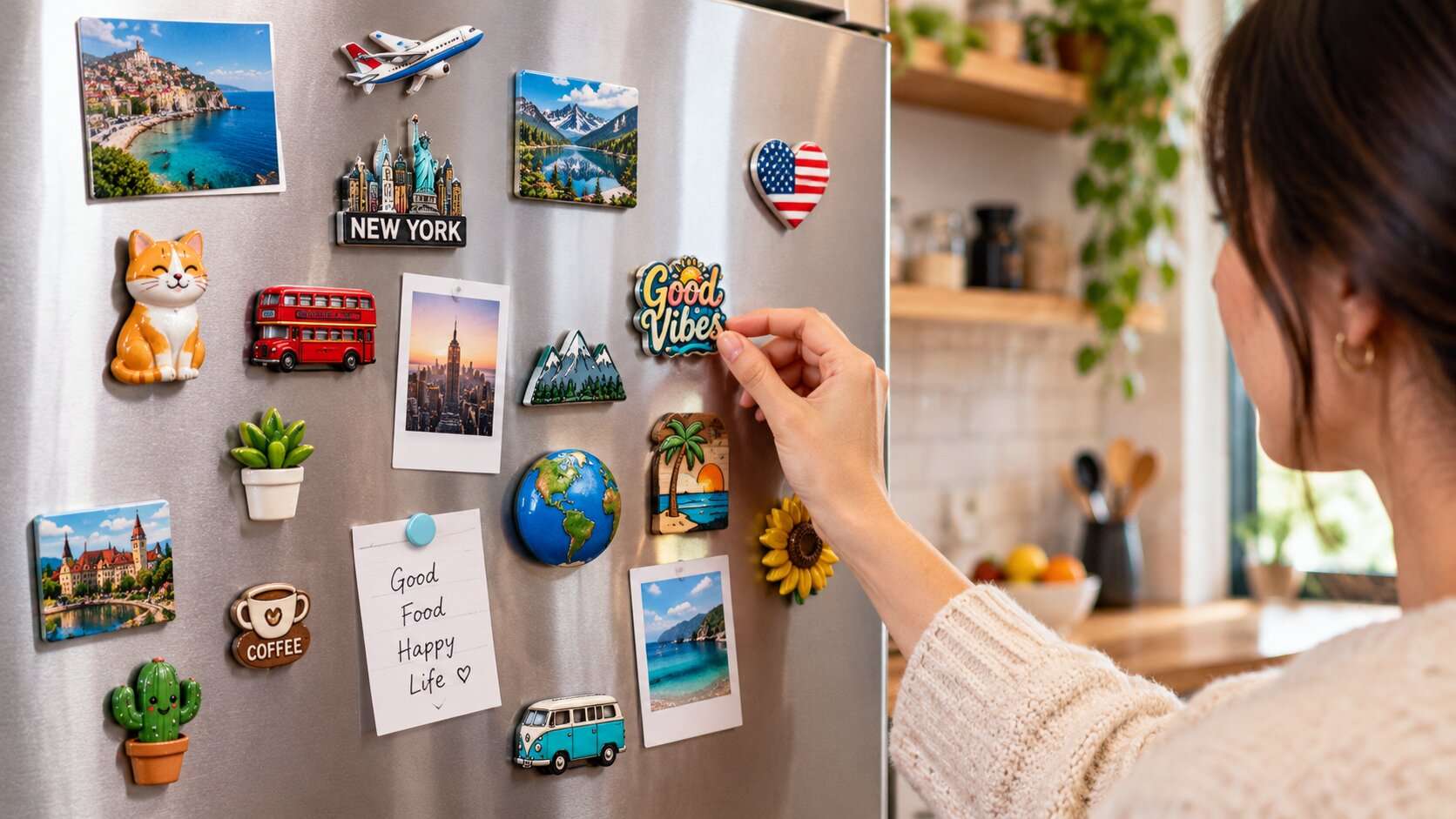
Walk into someone's kitchen and your eyes land on the fridge door before you reach for a glass. A tram from Lisbon. A child's drawing. A pizza coupon. A dentist reminder. It feels a little like reading a stranger's diary.
So do psychologists agree that a fridge door exposes your personality? Not in the way the headline suggests. No study has validated refrigerator magnets as a personality test. But the idea is not baseless either. Research on personal spaces, home display and souvenirs explains why the fridge door says something real about you, and why it is so easy to misread.
Here is what the magnets on your refrigerator door can reveal about you, what they cannot, and how to read them without fooling yourself.
The closest thing to a scientific foundation comes from personality psychologist Sam Gosling at the University of Texas at Austin. His teams studied bedrooms and offices, not kitchens. They compared what trained observers inferred from a person's belongings with the person's own Big Five personality scores. Observers could read some traits better than chance, and openness and conscientiousness came through most clearly.
Gosling sorts the cues in a space into three kinds:
A fridge door usually holds all three at once. That is why it is so rich as a clue, and also why one magnet alone tells you very little.
Gosling is also clear about the limits. He describes the method as imprecise, and people can misread what they see.
Here is where the evidence stands for fridge doors specifically:
Anthropologist Anthony Graesch and colleagues at UCLA studied how American families live with their belongings. In their sample, families kept an average of 52 items on the fridge, from party invitations to school schedules to magnets. Graesch describes the fridge as a repository of family memory and a place to schedule everything happening in a household.
Researcher Laurel Swan examined fridge surfaces in British homes and found that the door sits at the centre of shared family life. Routines such as a weekly schedule depend on where it is placed, so the door doubles as a negotiation space for who does what.
Fridge magnets are also unusual among souvenirs. A 2024 paper in Annals of Tourism Research by John Byrom and colleagues notes that they have one specific home in the house, and they do a practical job too, because they hold things up.
So your fridge door mixes public display with private logistics. Every visitor sees it, and you touch it several times a day. That daily exposure is why its contents carry so much weight.
Treat everything below as a starting question, not a verdict.
Byrom's team interviewed people about their magnets and found that the magnets generate and protect memories, usually triggering positive feelings. Souvenirs more broadly are part of how people present themselves, so a door full of destinations may mean that travel is part of how someone sees themselves.
Check one thing first: who bought them? Magnets given by friends say more about how friends see you than about where you have been.
Photos of loved ones are classic feelings regulators. Graesch's point is that the fridge space communicates what matters to a family. Look at whose achievements are displayed, and at what height. A drawing at a toddler's eye level suggests a door built for the whole household, not just the adults.
A calendar held by a magnet tells you the fridge is the household's control panel. Expired coupons and last year's invitations are behavioral residue: intentions that never got finished. That is a fun observation and a weak diagnosis. Plenty of organised people have a crowded door.
A cartoon is an identity claim about your sense of humor. A motivational quote usually shows what you want to be reminded of, which is not always who you are today. In interviews, Gosling has pointed to inspirational posters as a cue that tends to go with higher neuroticism. Treat that as a tendency across many people, never a rule for one person.
Magnets that carry a place, a craft or a historical story, such as cultural relic fridge magnets inspired by museum-style designs, often point to attachment to a place or tradition. Again, it may simply be a gift from someone who thought of you.
A plumber's number or a pizzeria's menu usually stays because it is useful, not because it expresses anything. The more interesting signal is what you keep when you could easily throw it out.
Word and letter magnets invite everyone in the house to write on the door. That can hint at a playful household where the door is a shared space, but it is the rarest and least studied of these cues.
A neat grid, a layered collage, and a clear front with a busy side all look like personality statements. Gosling's logic about behavioral residue suggests that arrangement may reflect habits, and in his bedroom and office work, organised spaces tended to go with conscientiousness. Nobody has tested that on fridge doors.
Practical reasons explain a lot too:
If you want a quick read, look at the pattern across several items instead of any one detail.
An empty door is not a red flag. Many stainless steel fronts do not hold magnets, because some stainless steels are not magnetic enough. Glass or panel-fronted smart fridges also leave little to stick things to. Renters, minimalists and private people may keep the door clear on purpose.
What a bare door does tell you is narrower: the fridge isn't this household's memory or scheduling board. That says nothing about whether the person has memories or a calendar.
If your magnets slide down or won't hold on a door that should work, the cause may be the magnet itself rather than the surface. This guide to how fridge magnets are made explains what makes a magnet stay flat and hold on a real door.
The same 2024 research found that magnets can also be tied to ambivalent memories, and sometimes their role is more about forgetting than remembering. A souvenir from a trip that ended badly, or from a relationship that did not last, can sit on the door for years.
That makes the fridge door a form of emotional curation. If one magnet makes you wince every morning, moving it is a perfectly reasonable choice. The door does not have to be a museum of everything that ever happened to you.
Stand in front of your own door and answer these in writing:
Your answers will tell you more than any personality label. They show what you value, whose presence you want nearby, and what you may be ready to let go of.
They can offer clues about your values, relationships and habits, but there is no validated link between a specific magnet and a trait. Research on bedrooms and offices shows that possessions carry some personality information, and its author warns that the cues are easy to misread.
It often means travel is a meaningful part of your life, and the magnets help you revisit memories. It can also mean friends bring them back for you. The meaning lies in how you use them, not in the collection itself.
No. Doors accumulate items over time and double as household schedulers. Clutter is more likely to reflect a busy household than a personality flaw.
Some grades of stainless steel are weakly magnetic or non-magnetic, so magnets can slip or fall. Panel-fronted and glass-fronted fridges have the same problem.
Psychologists do not agree that a fridge magnet is a personality test. What they do agree on is the broader principle: the objects we keep around us reflect, and sometimes shape, who we are. Your fridge door is one of the most visible places this plays out, a mix of identity, memory and daily logistics.
Read it as a story, not a score. The most useful question is not what your magnets say about you, but whether the door reflects the life you want to be reminded of. If you are choosing new magnets, start with ones that mean something to you, perhaps from a fridge magnet collection with designs worth looking at every day.
Silver looks the same on a shop shelf whether it is sterling, plated brass or something in between. That is why check
READ FULLA stand collar can sit well on one customer and choke another. A “linen” tag can hide a fiber that shrink
READ FULLFrog buttons are the knotted loop-and-button closures known in Chinese as pankou (盘扣). A pankou is made of two pa
READ FULL